
No-Knead Sourdough Boule
About this recipe:
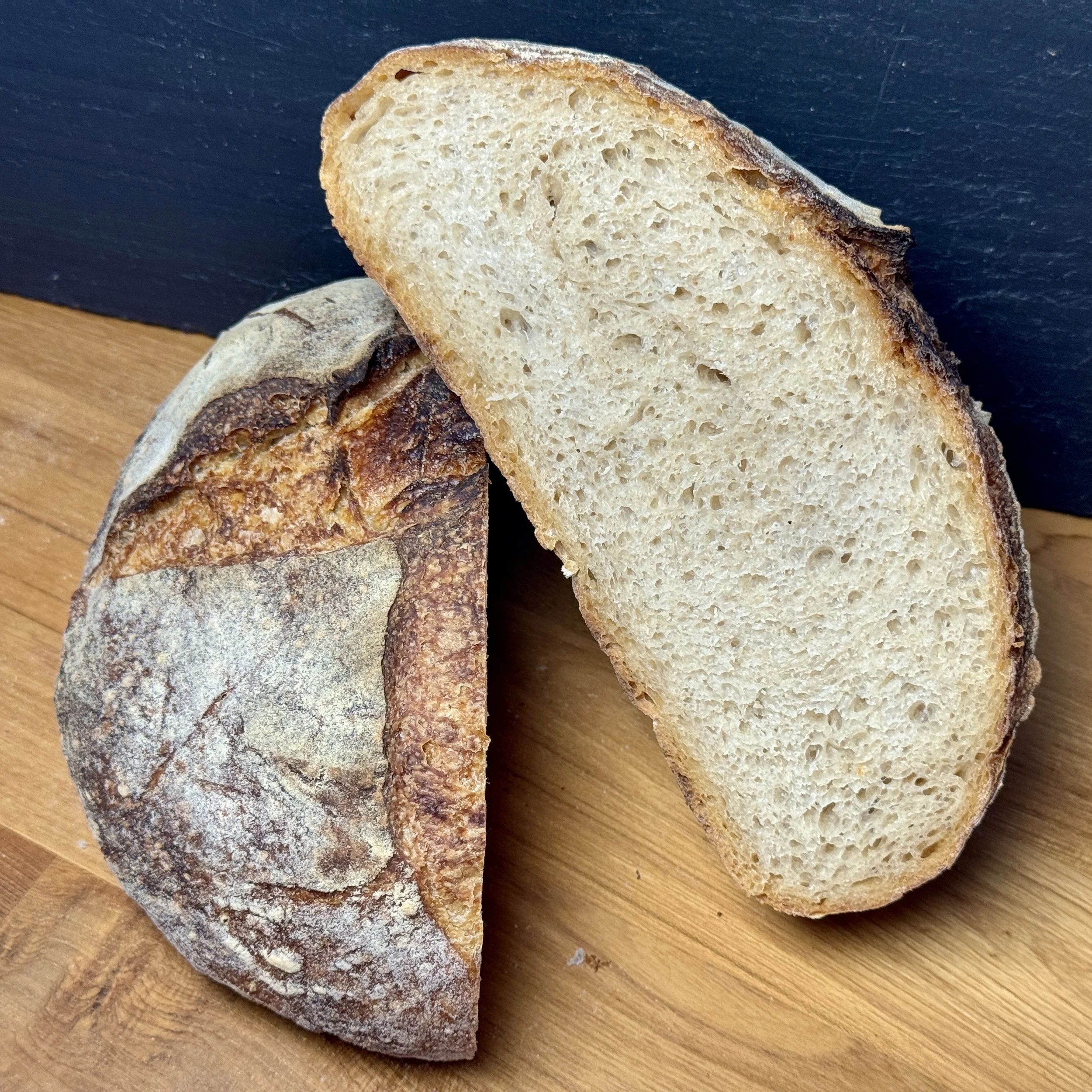
There are many misconceptions about what kneading actually does to bread. Initial kneading is really all about evenly distributing moisture to hydrate the starches and proteins in the flour, NOT stretching or organizing gluten in the dough. Despite popular belief, gluten is self organizing and doesn’t require kneading to create an elastic, web-like network of protein strands that help trap the air bubbles (carbon dioxide produced by the yeast and bacteria in the starter), creating the open texture of a properly proofed loaf. The key to gluten development is actually proper hydration. This can be achieved by kneading to distribute the water throughout the dough, or through resting, giving the dough enough time to allow the starches and proteins (and fiber) to fully absorb the water before baking. For that reason, this dough has a moderate hydration ratio (around 66%—600g total flour, to 400g total water including the starter). Although no “kneading” is required, a good shaping and final proofing prior to baking will help give the loaf a proper structure and even bake. The more closed-crumb structure of this loaf (smaller, more evenly spaced air bubbles) make it an excellent sandwich bread.
Ingredients:
500g Bread Flour or Blend of Flours*
300g Filtered Water**
200g Fed Starter
10g Kosher Salt
Directions:
Prepare the Dough:
In a large measuring cup, combine 300g warm Water (90-100ºF) with 200g revived Sourdough Starter/Levain (fed the day before, and left at room temperature at least 12 hours), and stir or whisk to until the liquid becomes homogeneous. In a large mixing bowl, combine the Flour(s) and Salt, and whisk to combine.
Pour the starter into the flour and use a wooden spoon or rubber spatula to mix until the dough comes together. Using your hands, continue mixing the dough until all the dry flour is incorporated and no lumps are visible. The dough will be shaggy and somewhat sticky.
Initial Proofing:
Lightly flour a clean counter or board, and turn the dough out. Wipe out the mixing bowl (or wash and dry if necessary), and using floured hands, return the dough to the bowl. Cover with plastic wrap or a damp tea towel and rest at room temperature 10 to 24 hours until at least doubled in size.
Shape the Loaf:
On a well-floured clean counter, and turn the dough out. The dough will deflate considerably, and be quite loose. Using floured hands, pull the edges of the dough into the center working your way around the dough until a tight ball has formed. It should be less than half the size it stared as.
Final Proofing:
Lightly dust a sheet of parchment paper with a 50/50 blend of rice flour and bread flour. Using a bench scraper or wide spatula and your hand, scoop up the dough and invert it, seam side down, in the center of the parchment.
Lightly dust the top of the loaf with the rice flour mixture, cover with a clean, dry tea towel, and rest until nearly doubled in size (90 min - 2 hours).
Score & Prepare for Baking:
About an hour into the final proofing, place a large cast iron ***Dutch Oven (with lid) on the lower middle rack of the oven, and preheat it to 450ºF for at least 30 minutes.
Uncover the dough and use a bakers lame, razor, or sharp knife to score the loaf with a single, off-centered slash from end to end, X pattern, or Freehand design, about 1/4-inch deep.
Bake & Rest the Loaf:
Remove the lid from the Dutch Oven and carefully lower the dough into the pot using the parchment paper.
Cover with the lid, and bake 20 minutes. Remove the lid, and continue baking an additional 30-40 minutes, until deeply brown.
Remove the pot, and using tongs, lift the loaf out. Place it on a wire rack to cool at least 45 minutes before slicing. This dough has a lower hydration ratio than an artisan loaf, and doesn’t rely as heavily on carryover cooking to fully cook the center of the loaf.
As the dough cools, the crisp crust will soften, and then re-harden slightly. This is essential to finish the internal cooking process. Slicing it too soon will cause the core to become dense and chewy. This type of bread is best toasted or grilled before serving (grilled cheese, anyone?).
Notes:
*Flour:
There are many different types of flour available for baking. 100% “Bread Flour” can be used, or a blend of flours:
• 375g Bread Flour + 125g Whole Grain Flour: Wheat, Rye, or Spelt, or a multi-grain combo totaling 125g.
• 425g Bread Flour + 75g Oat or Buckwheat Flour
Buckwheat and Oats are not wheat and do not contain gluten, so a lower ratio is used for proper gluten formation. Using more than 15% (of the total flour weight) buckwheat or oat flour will not produce a good gluten structure and will lead to a dense or crumbly texture. Higher ratios can be achieved by adding “Vital Wheat Gluten” or “Gluten Flour” at around 6% by weight of the Buckwheat or Oat Flour (i.e. 375g Bread Flour + 118g Oat Flour + 7g Gluten).
Whole Wheat, Rye, and Spelt Flours contain bran, the outer coating of the wheat berry. Bran absorbs more moisture, but also has sharp edges which can cut gluten strands, using a higher ratio of Whole Grain Flours can lead to poor gluten development and dense or flat loaves.
**Water:
If your home is serviced by municipal or treated water (chlorinator or softener), it is best to use bottled or distilled water. Chemicals and minerals in treated water can inhibit the development of gluten or the damage the micro-organisms in your starter leading to a slack, or under-proofed dough.
***Baking w/o a Dutch Oven:
If you do not have a large Dutch oven, adjust two racks to the lowest and middle positions. Place a cast iron or heavy, oven-safe skillet on the bottom rack of the oven, and a heavy baking sheet or pizza stone on the middle rack. Preheat for at least 30 minutes. When you are ready to bake your loaf, use a pizza peel (an upside down sheet pan works too, or—carefully —by hand) to slide the loaf and parchment directly onto the pizza stone/baking skeet. Carefully add 3-4 cups of water to the skillet (steam will erupt instantly). Quickly close the oven door and bake 20 minutes in the steamy oven. If the water fully evaporates before the initial 20 minutes is up, add an additional cup of water. Continue baking an additional 30-40 minutes, until deeply brown.
Use a pizza peel or sheet pan to slide the bread and parchment out of the oven and place it on a wire rack to cool at least 45 minutes before slicing. This dough has a lower hydration ratio than an artisan loaf, and doesn’t rely as heavily on carryover cooking to fully cook the center of the loaf.
As the dough cools, the crisp crust will soften, and then re-harden slightly. This is essential to finish the internal cooking process. Slicing it too soon will cause the core to become dense and chewy. This type of bread is best toasted or grilled before serving (grilled cheese, anyone?).